
Significant Losses Across the Board
The examples of financial distress are numerous. ALT5 Sigma Corp., which possesses the WLFI token from the Trump-affiliated World Liberty Financial Inc., has seen its value drop nearly 50% in just over a week. Similarly, Kindly MD Inc., a healthcare services provider that owns Bitcoin through its subsidiary Nakamoto Holdings, has experienced an approximate 80% decline since its peak in May. Other digital-asset treasury firms associated with cryptocurrencies such as Ether and Solana have also faced considerable losses, thereby reducing the perceived worth of the tokens they hold.
A Saturated Market with Little Distinction
According to Ed Chin, co-founder of Parataxis Capital, which recently invested in a Bitcoin treasury company in South Korea, there is an oversaturation of such firms in the United States with minimal differentiation among them. Many of the over 100 companies that have emerged this year, primarily small enterprises, have rebranded quickly — including a Japanese nail salon, a cannabis business, and a marketing agency. Nevertheless, there are still a few firms managing to capitalize on the speculative environment; for instance, Eightco Holdings Inc. saw its shares skyrocket by over 3,000% following the announcement of a plan to purchase Worldcoin and the appointment of Wall Street analyst Dan Ives to its board.
Access to Crypto through Traditional Structures
For some investors, the allure of publicly traded companies is evident, as they provide a means to gain exposure to cryptocurrencies with the potential for amplified returns, all wrapped in a recognizable equity format. In certain instances, this business model still commands solid premiums. However, the market has become increasingly congested, with a multitude of firms rushing in and offering little beyond their held tokens. As prices decline, the confidence that upheld those premiums is beginning to unravel.
Declining Bitcoin Purchases Indicate Potential Issues
Recent data from CryptoQuant suggests that the digital-asset treasury model may be faltering under its own weight, both in terms of market sentiment and the actual buying of Bitcoin. In August, these firms acquired only 14,800 Bitcoin, a sharp decrease from the 66,000 purchased in June. Additionally, the average size of these purchases has diminished significantly, dropping to just 343 Bitcoin last month, which marks an 86% decline from the peak in 2025. The growth rate of total Bitcoin holdings has also slowed considerably, with treasury firms’ accumulation rate plummeting from 163% in March to a mere 8% in August.
Innovations Amidst Volatility
In recent months, many digital-asset treasury firms have ventured into more innovative financing solutions. Crypto lenders, brokerages, and derivatives desks have created a tailored financing ecosystem for these treasury firms, offering options like Bitcoin-backed loans and structured payouts. For some companies, these financial instruments provide the speed and flexibility that traditional banks cannot match. However, for others, such strategies could lead to increased risks, layering additional uncertainties onto already volatile assets or sacrificing long-term gains for immediate yields, especially as the margin for error tightens.
New Approaches to Debt Management
Smarter Web Co., a London-based web design firm that holds Bitcoin, has issued a bond linked directly to the cryptocurrency’s value rather than to traditional currencies. This means that if Bitcoin appreciates, the amount owed by the company increases. Smarter Web’s CEO, Andrew Webley, explains that only 5% of the firm’s treasury is exposed to this bond, positioning it as less risky than conventional fiat debt. He argues that if Bitcoin rises, as long as their shares appreciate more than Bitcoin, it will convert into equity. Conversely, if Bitcoin declines, the firm is insulated from significant losses, with the worst-case scenario being the repayment of the debt in Bitcoin.
Shifting Strategies and Market Responses
DDC Enterprise Ltd., a formerly struggling food company, has gained access to over $1 billion, most of which remains untapped, through a mix of equity offerings and debt instruments. However, its stock has also recently tumbled after a prior surge. DDC did not respond to inquiries for comments. The Nasdaq, where many of these firms are listed, is reportedly beginning to require some of these token-holding companies to seek shareholder approval before issuing new shares for token purchases. This share-sale model has been crucial for digital-asset treasury firms to raise capital without incurring debt.
Market Leaders Not Immune to Changes
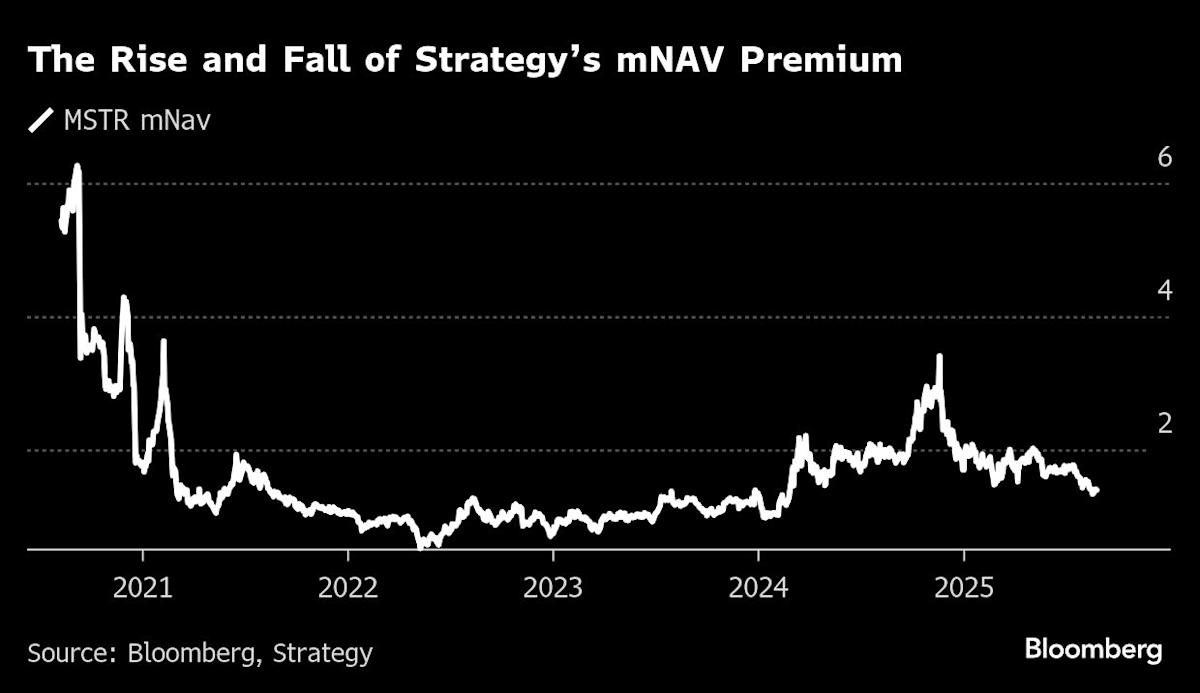
Two of the most recognized digital-asset treasury firms, Strategy and its Japanese counterpart Metaplanet Inc., have also witnessed declines in their stock prices after enjoying substantial gains over the past year, indicating that even industry frontrunners are not shielded from the shift in market sentiment. Recently, Strategy was excluded from the S&P 500 index rebalancing, despite meeting the necessary eligibility criteria. Its stock price has remained stagnant since April, even as Bitcoin has experienced a resurgence, leading to a reduction in its Bitcoin to market capitalization ratio—referred to as mNAV—to approximately 1.5. On Monday, the company purchased a modest $217 million worth of Bitcoin via its at-the-market offering.
Rising Demand for Flexible Financing Solutions
The increasing demand for adaptable financing has caught the attention of crypto lenders. Two Prime, a firm that offers Bitcoin-backed loans, is experiencing heightened interest from digital-asset treasury companies, according to CEO Alexander Blume. The company typically underwrites loans ranging from $10 million to $500 million and currently holds $1.25 billion in active loans. Recently, it introduced a loan structure with fixed repayments at maturity, eliminating monthly interest payments, designed to provide borrowers with more flexibility in volatile markets. “Bitcoin treasury companies are an expanding area for us,” Blume noted. “We’ve observed larger loan sizes over the past year.”
The Future of Digital-Asset Treasury Companies
Whether this new financing ecosystem will bolster the business model or simply delay its inevitable decline remains uncertain. The next phase may not involve a dramatic collapse but rather a gradual decline, as stock prices continue to fall and token acquisitions stall. Some investors are finding it challenging to comprehend the rationale behind investing in these companies layered with expenses and risks, rather than directly purchasing cryptocurrencies or through exchange-traded funds (ETFs). “I’ve been trying to convince myself to invest in some of these digital-asset treasury firms,” stated Travis Kling, chief investment officer at Ikigai Asset Management. “I haven’t managed to do it yet. I may never do it.” To him, the entire setup seems like “the final breath of a cycle that couldn’t come up with anything more substantial than this absurdity.”


